

Few roles sit closer to global disruption than reputation leadership in 2026. Trade tensions, tariffs and supply-chain shocks are reshaping geopolitical relationships. Regulatory agendas are shifting rapidly across markets. AI is colliding with geopolitics and public policy while also accelerating misinformation risks. And organisations are facing scrutiny from an ever-wider array of stakeholders.
Our survey highlights the sheer breadth of forces now shaping the profession. AI tops the list of factors expected to influence reputation leadership in 2026, but it sits alongside a range of other powerful and shifting currents.
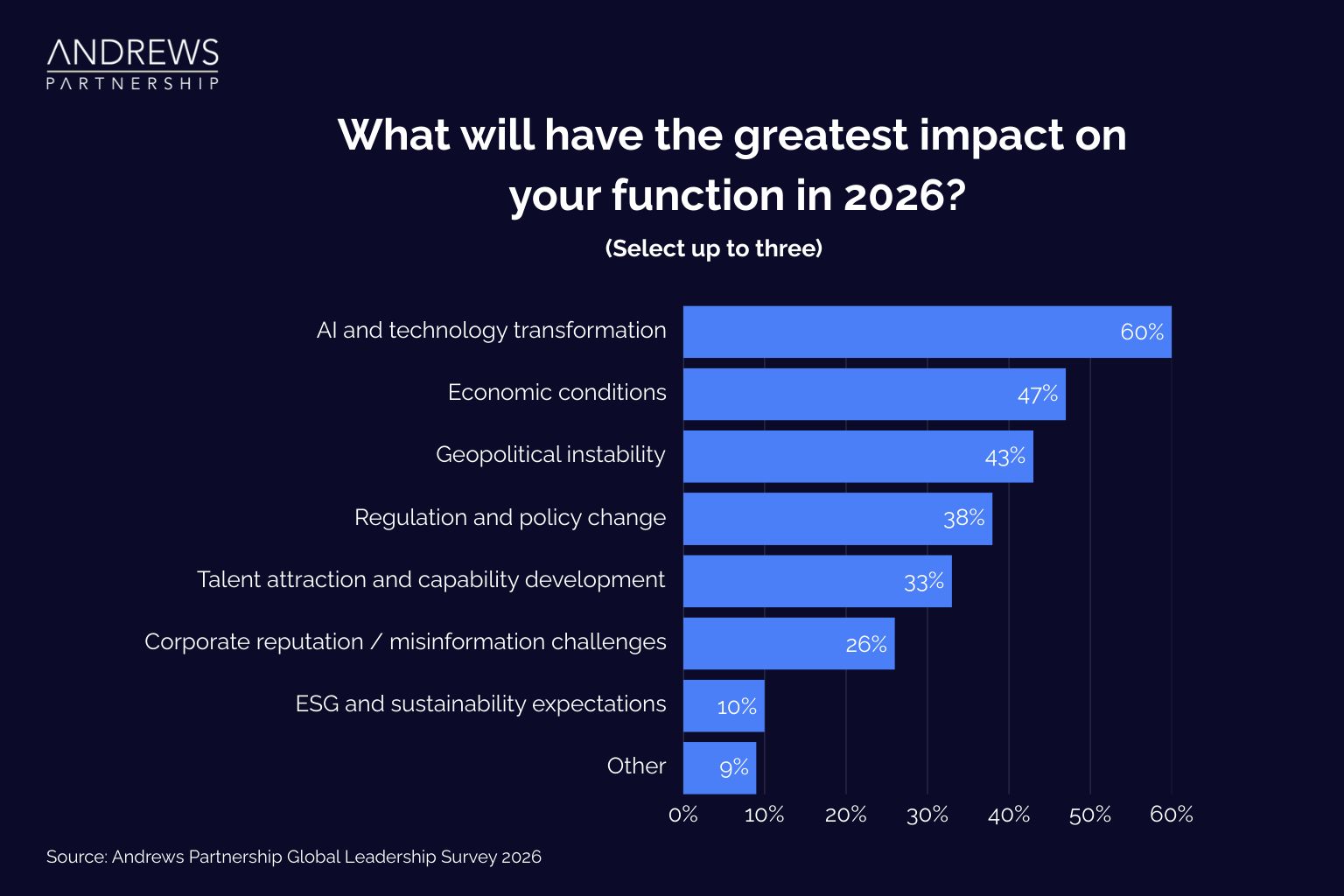
Rather than responding to a single dominant issue, reputation leaders must manage a wide spectrum of risks and opportunities, often unfolding across multiple regions and stakeholder groups at once.
At AP, we describe this environment as one of polycrisis: a landscape in which geopolitical tensions, economic pressures, regulatory developments and technological disruption interact and reinforce one another.
A regulatory announcement can influence market sentiment, geopolitical developments can trigger policy changes and technological breakthroughs can reshape investor expectations almost overnight.
Respondents repeatedly highlighted the need for adaptability and composure in the face of continuous change. An APAC-based communications leader in the technology sector captured this tension succinctly: “There is a lot of industry volatility with every AI announcement impacting share price. Staying calm, confident and above the fray is the way to win.”
Or as one respondent put it: “Get comfortable with being uncomfortable.” Others emphasised the need for “nimbleness to pivot according to fluid changes” and the ability to respond to a “volatile and changing landscape and economy.”
But operating in this environment can also place considerable pressure on leaders themselves. Several respondents referenced the personal demands of navigating continuous disruption, including “burnout, and keeping ahead of the AI curve.” One respondent summarised the reality more bluntly: successful leadership increasingly means “staying calm amidst utter chaos.”
As we’ve explored in our work on resilience in the industry, the ability to remain agile, composed and provide clear counsel amid uncertainty is becoming a critical leadership capability.
Faced with a permanently complex operating environment, many leaders are rethinking not just the need for personal resilience, but how to build resilience into their function design and capabilities. Our survey shows that teams are already responding – adopting new technologies and reconsidering organisational structures to better navigate the pressures shaping the profession.