


In 2019, Andrews Partnership conducted a research project to determine trends of where regional leadership were concentrating. What we found is that 5% where then sat in Mainland China – with clear signals this was going to increase. However COVID disrupted that trajectory with a shift of China then reporting into global HQ’s. While this has strengthened alignment with global leadership, it has also reduced the opportunity for China-based leaders to take on regional roles.
This has created a more practical retention challenge. A consistent request we see at Andrews Partnership is for broader exposure and scope – but in many cases, organisations are no longer able to offer that through geographic expansion of roles. Mobility has also remained relatively low for China-based leaders, with fewer taking on assignments outside of China, further limiting access to broader experience.
As a result, organisations are having to think differently about how they provide that exposure and retain senior talent – not just through role design, but through other forms of development.
This is where executive education is increasingly coming into focus.
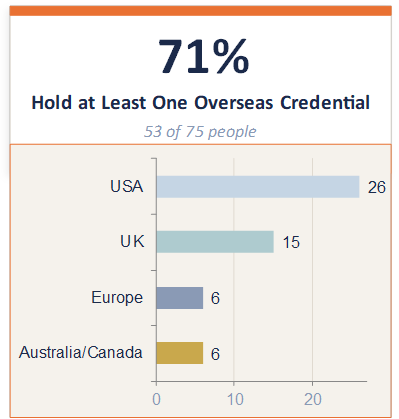
Andrews Partnership recently assessed a cohort of 75 of the most senior Corporate Affairs and Government Affairs leaders operating in China.
In a market where demand continues to outpace supply, retention is no longer just about compensation. Increasingly, it is about investment, signalling, and long-term career design.
Leadership education is being used more deliberately as a retention tool. This includes MBAs, executive programs and specialist leadership development aligned to corporate strategy, reputation and enterprise leadership expectations.
“In China, leadership education is increasingly being used as a signal of long-term investment in talent – not just a development tool.”
Andrews Partnership
For many leaders, access to international learning, peer networks and global exposure carries real weight. It signals both longer-term career trajectory and alignment to global leadership.
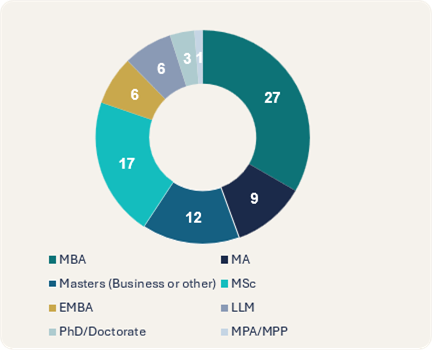
The Andrews Partnership dataset highlights how embedded international education already is within this cohort:
MBAs are the largest single category, but they are not the story in isolation.
What matters is what leadership education represents:
“The value of an MBA (or Masters) in China is less about the qualification itself, and more about what it signals – global credibility and readiness for senior leadership.”
Andrews Partnership
The more distinctive dynamic in China is not just the prevalence of leadership education, but the nature of the roles themselves.
Senior Corporate Affairs and Government Affairs leaders are required to operate across multiple systems – navigating global corporate expectations alongside local regulatory and stakeholder environments.
This creates a need for what might be described as “bridge capability.”
Leadership education supports this by developing:
Across both multinational and Chinese organisations, the most effective leaders are those who can move between these contexts and align local realities with wider business priorities.
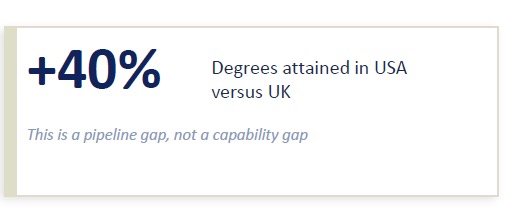
The data also highlights a structural imbalance in where these qualifications are being obtained.
US programmes outnumber UK qualifications by approximately 40% on a volume basis.
This is less about quality and more about pipeline and positioning. US institutions have historically been more embedded within multinational leadership pathways, with stronger corporate connections and alumni networks.
Leadership education is only one part of the retention equation. Chinese headquartered firms often take a different approach.
While base salaries may sit below multinational benchmarks, total remuneration is more heavily weighted towards long-term incentives (LTIs). These structures are designed to retain talent over time by linking compensation directly to company performance and deferring value.
In one example, a 38-year-old Government Affairs leader in financial services, formerly from MOFCOM, held approximately USD 800,000 in LTIs. The practical outcome was clear: there was little incentive to move, and no multinational would realistically buy out that position.
“Multinationals tend to retain through development and exposure. Chinese firms retain through structure – particularly long-term incentives.”
Andrews Partnership
The key point: retention in China is not one-dimensional.
Leadership education is not a standalone solution. But it is becoming a more deliberate and strategic lever. The question for organisations is not whether to offer it, but whether they are using it effectively to:
Used well, it strengthens both retention and capability. Used poorly, it becomes a transactional benefit.
The thinking required by Chief Corporate Affairs Officers and CHROs is this: the organisations that will retain top talent will be those that take a more deliberate approach – combining compensation structure with meaningful leadership development. Drawing on the experience of Andrews Partnership team members who have worked in China for over 16 years in Corporate Affairs and Government Affairs talent and advisory, we have seen first-hand how both the talent landscape and retention dynamics have evolved.