
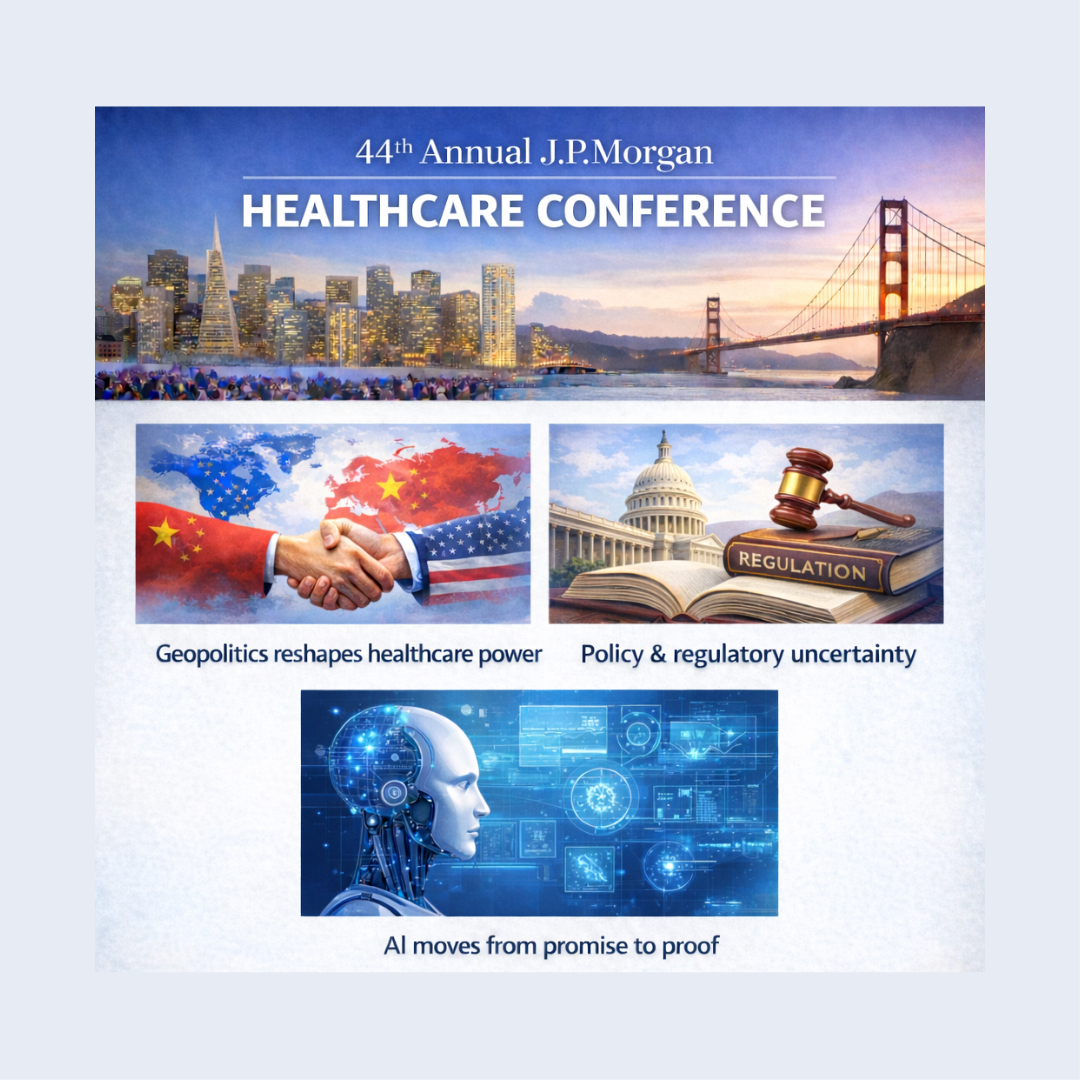
This year’s JP Morgan Healthcare Conference is already making clear that companies are being judged on far more than innovation and growth. Here, we highlight four signals from the conference that matter most for industry leaders shaping reputation, policy positioning and long-term credibility.
With dealmaking momentum accelerating and global risk factors multiplying, the signals emerging this week matter well beyond the hotel conference suites of San Francisco.
1. Geopolitics is reshaping the healthcare power map
The most consequential signal from JPM26 is geopolitical rather than financial. New data presented during the conference showed that Asia-Pacific overtook North America in accelerating cell and gene therapy clinical trials in 2025. While the US still leads China in absolute numbers, the pace of change is striking: US trial activity rose 8% year-on-year, while China recorded 20% growth.
That shift has sharpened debate about whether China’s biotech acceleration represents a strategic inflection point, framed by some as a potential “Sputnik moment” for US biotech.
Healthcare innovation is no longer insulated from geopolitics and global power shifts. It’s increasingly bound up with industrial policy, national competitiveness, supply-chain resilience and technology sovereignty. For global healthcare companies – particularly those operating across the US and China – neutral positioning is becoming harder to sustain, yet overt politicisation carries reputational and operational risk of its own.
For corporate and government affairs leaders, this demands a mature geopolitical narrative: one that acknowledges strategic competition without inflaming it, and that explains global footprint decisions in terms of resilience, access and long-term value rather than cost efficiency alone.
2. Policy and regulatory uncertainty is centre stage
Closely intertwined with geopolitics is a second theme: policy uncertainty is no longer background noise, it’s shaping confidence, capital allocation and reputation in real time.
Pricing remains a live issue, heightened by the Executive Order on Most-Favoured-Nation (MFN) drug pricing in the US – a policy to align American prices with the lowest prices paid in comparable markets. In parallel, regulatory predictability itself is under strain. In a letter circulated during the conference, biotech investor Noubar Afeyan warned that policy volatility risks undermining long-term innovation, arguing that short-term political decisions could weaken the foundations of the healthcare ecosystem.
Those concerns were reinforced when a former US Food and Drug Administration official described the agency as operating amid disruption caused by political interference and leadership churn, raising questions about review timelines, decision-making consistency and regulatory confidence during a STAT event at JPM.
Change is needed for the US to keep pace with China and its “ability to get clinical data cheaper and faster,” said venture capitalist and former pharma CEO John Maraganore. “That requires some regulatory reform, it requires some health policy reform, and that’s what we should really think about here.”
For government affairs leaders, passive monitoring isn’t sufficient. Companies need articulated, defensible positions on pricing, access and regulatory reform – and must be prepared to explain them publicly. For corporate affairs leaders, rapid policy shifts must be translated into clear external narratives that acknowledge uncertainty without amplifying risk or eroding trust.
3. AI moves from promise to proof
Against this shifting backdrop, AI is no longer being pitched as a future capability, but as a core strategy to drive efficiency, scale and growth.
In the week before JPM26, Anthropic launched Claude for Healthcare, designed specifically for clinical documentation, biomedical research and regulated workflows. At the same time, OpenAI introduced OpenAI for Healthcare, explicitly focused on safety, governance and real-world deployment with providers and life sciences companies. Frontier AI is moving decisively into healthcare-specific, compliance-ready use cases.
That shift was reinforced by Eli Lilly’s conference announcement of a US$1bn partnership with NVIDIA to establish a new AI-powered “co-innovation lab” focused on drug discovery and development – a move that underscored how seriously large-cap pharma is now backing AI as core infrastructure rather than peripheral tooling.
That evolution is visible across discussions at JPM. Leaders are showcasing AI use cases that compress cost and cycle time: automation in revenue integrity, AI-led prior authorisation and clinical documentation that all move EBITDA. The bar has shifted decisively to measurable return on investment.
For corporate reputation leaders, the narrative task is explaining not just what AI delivers – but where its limits lie. The rise of healthcare-specific AI platforms sharpens questions of accountability, data governance and regulatory readiness. Over-promising on AI without evidence now creates credibility risk rather than differentiation.
4. A more considered phase for healthcare M&A
Against geopolitical tension, policy uncertainty and rising demands for proof, dealmaking at JPM26 is resilient – but more selective.
Drugmakers struck US$130bn of deals in 2025, more than double the previous year, as confidence returned and capital markets reopened. Patent cliffs remain a structural driver with nearly 12% of global pharmaceutical revenues at risk over the coming years, forcing companies to seek new growth pathways including acquisitions.
Notably, JPM26 itself has so far lacked the flurry of headline-grabbing, big-name deal announcements that often dominate the opening days of the conference. But that absence is arguably less a signal of caution than of timing.
Deal activity has been positive in the months leading into January, with many companies addressing pipeline gaps, patent exposure and portfolio priorities well before arriving in San Francisco. In that context, JPM is functioning less as a launchpad for rushed transactions and more as a forum for validation – a place where management teams explain how recent deals fit into longer-term strategies, and where investors test whether those moves are built to last.
For corporate affairs leaders, the absence of splashy announcements doesn’t reduce scrutiny. With fewer “headline moments” to lean on, companies are being judged on the credibility of their integration plans, their access assumptions and their ability to articulate why transactions strengthen resilience rather than simply add scale.
Why healthcare strategies demand resilience, not just innovation
Across MFN pricing, patent cliffs, policy and geopolitics, one overarching shift is becoming clear: healthcare strategy is being judged as much on resilience and credibility as on innovation and growth.
For corporate and government affairs leaders, this demands a focus on how value is articulated and defended. Narratives must be anchored in evidence, not aspiration; shiny innovation without proof of durability no longer carries the day.
As complexity deepens across every dimension – scientific, regulatory and geopolitical – the strategic value of corporate and government affairs lies in the ability to translate that complexity into clarity: for boards weighing capital allocation, investors assessing exposure, policymakers questioning value and the public whose trust healthcare companies ultimately depend upon.
JPM has always been a moment of signal rather than certainty. In 2026, it signals that those who build for resilience, not just momentum, will shape both reputation and results in the year ahead.